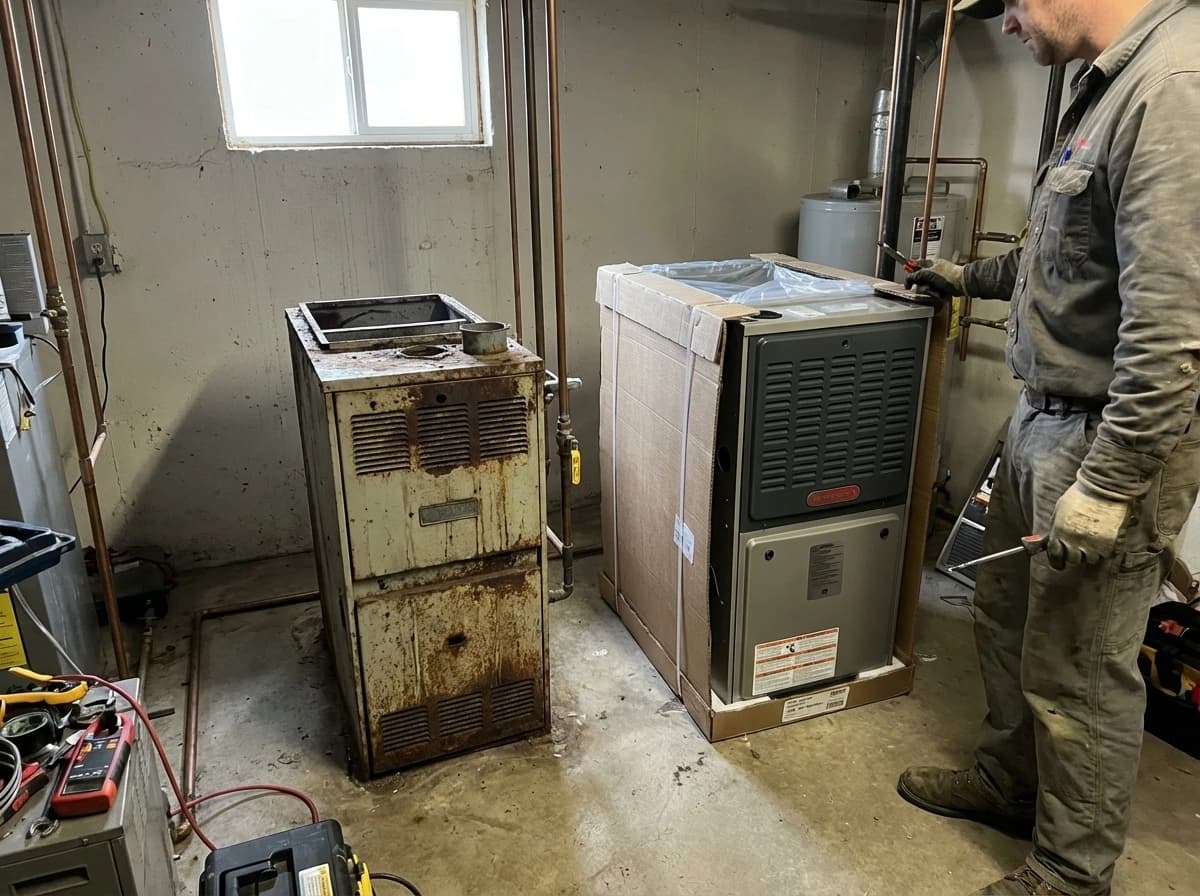
Should You Repair or Replace Your Furnace?
Sometimes repair makes sense. Sometimes it's throwing good money after bad.
Your furnace stops working on a cold January night. The technician diagnoses a failed heat exchanger. Now you're facing a decision: spend $1,500 on the repair, or $6,000 on a new furnace. Which makes more sense?
This question doesn't have a one-size-fits-all answer. It depends on your furnace's age, condition, the specific repair needed, and what makes financial sense for your situation.
Here's a framework for thinking through the repair-vs-replace decision for furnaces in Boise and the Treasure Valley.
Start with Age
Furnaces typically last 15-20 years with proper maintenance. Some go longer, some fail earlier. But age matters because older furnaces have more problems waiting to happen.
Under 10 years old: Generally worth repairing unless the repair costs more than 50% of a new furnace. You've got years of life left.
10-15 years old: The gray zone. Major repairs deserve serious consideration. Minor repairs are usually still worthwhile.
Over 15 years old: Replacement starts making more sense, especially for expensive repairs. Even if this repair works, another failure is probably coming soon.
The 50% Rule
Here's a common guideline: if the repair costs more than 50% of a new furnace, replacement usually makes more sense. For a $5,000 replacement, that means repairs over $2,500 warrant a new system.
Why 50%? Because an expensive repair on an aging system is a gamble. You might get five more years. You might get five more months. That's money you won't get back when the next component fails.
This rule isn't absolute. A three-year-old furnace with an unusual failure might justify a pricey repair because you're getting essentially new equipment back. Context matters.
Some techs use an even simpler formula: if (repair cost × furnace age) exceeds $5,000, replace it. A $500 repair on a 12-year-old furnace? That's $6,000—probably time to consider replacement.
What the Specific Repair Tells You
Not all furnace repairs are equal. Some are routine maintenance. Others signal deeper problems.
Minor repairs like ignitors, flame sensors, blower motors, and thermostats are generally worth fixing regardless of age. These parts wear out and are relatively inexpensive to replace.
Heat exchanger failures are different. Heat exchangers are expensive to replace, and a cracked exchanger can be dangerous (carbon monoxide risk). On furnaces over 15 years old, a failed heat exchanger usually means it's time to replace.
Control board failures on older furnaces can be problematic because parts availability becomes an issue. If the board for your 18-year-old furnace is discontinued, replacement might be your only option.
Repeated failures of different components suggest the system is generally wearing out. One repair leads to another. At that point, you're just prolonging the inevitable.
The Efficiency Angle
Older furnaces are less efficient than modern equipment. A 20-year-old furnace might be 80% efficient (or less), meaning 20% of your heating dollars go up the flue. New furnaces hit 95-98% efficiency.
Does that efficiency gain pay for a new furnace? Sometimes. It depends on your heating costs and how long you plan to stay in your home. For a Boise home spending $1,500/year on heating, a 15% efficiency improvement saves roughly $225/year.
That's real money, but it takes years to pay back a $5,000 furnace investment through efficiency savings alone. The math works better if you were already facing a major repair.
Efficiency shouldn't be the only reason to replace, but it's a nice bonus when replacement already makes sense for other reasons.
When Repair Usually Makes Sense
Here are situations where repairing your existing furnace is typically the right call:
When Replacement Usually Makes Sense
And here's when you should probably put that repair money toward a new furnace:
The furnace is over 15 years old and facing a repair over $1,000. At that age, more problems are coming.
The heat exchanger is cracked. This is both expensive to repair and potentially dangerous. On older furnaces, it's almost always time to replace.
You've had multiple repairs in the past few years. If you're on first-name basis with your HVAC tech, your furnace is telling you something.
Repair parts are discontinued. Some older systems simply can't be fixed anymore because no one makes the parts.
You're doing other home improvements and can bundle the replacement with other work. Sometimes the timing is right.
The Bottom Line
There's no magic formula, but here's a simple decision tree: If your furnace is under 10 and the repair is reasonable, fix it. If it's over 15 and the repair is expensive, replace it. Everything in between requires judgment based on your specific situation.
A good HVAC company will give you honest advice, not push you toward whatever makes them more money. If a tech tells you a repair is worth doing on an older unit, they're probably right. If they say it's time to replace, ask them to explain why.
Idaho winters are cold. You need heat you can count on. Sometimes that means repairing what you have. Sometimes it means investing in something new. Either way, make the choice with clear eyes.
Need Honest Advice on Your Furnace?
We'll diagnose the problem and give you straight talk about your options—repair or replace.